Wednesday, January 11, 2017

The Quest for More Power - adding ID1000 injectors and a custom tune

Overall, I was very happy with the Procharger "canned" tune for my 2013 Mustang GT A6.  One thing to note, the Procharger Phase 2 is the only centrifugal kit I could find that included an A6 tune in the kit.  Paxton and Vortech did not offer this feature.

The car was an absolute beast on the street with the Procharger tune, with one exception.  The 47 lb/hr injectors included in the kit are undersized for the application.  To make up for this, Procharger retains the stock 6800 pm redline, meaning you fall out of the powerband on upshifts on the A6.

I contacted Shaun from AED to perform a custom dyno tune on my car, and purchased a set of ID1000 injectors from Teambeefcakeracing  Shaun would not tune anything other than ID injectors, so I went with his advice.


ID1000 Injectors awaiting installation on the car

\
My good friend Frank trailered my car down to Shaun's shop, a 10+ hour round trip from Medford

The car in the shop, awaiting dyno tuning


The car initially put down 542 horsepower @ 6875 rpm and 431 ft lbs @ 5575 rpm, very peaky.


After dyno tuning, the car put down 561 horsepower @ 6975 rpm and 453 ft lbs @ 5500 rpm.  More impressive, the car gained an additional 1,000 rpm of powerband, made huge gains under the curve, and now makes 100 more ft lbs of torque on the 1-2 upshift due to the increase in powerband.


Overall I am very happy with Shaun's work, the car is insane to drive on the street now.  At the track, my previous best at 3800' DA was 12.0 @ 118 mph.  With Shaun's tune, the car has gone 11.56 @ 125, gaining 7 mph and dropping 5 tenths in the 1/4 mile.  Altitude corrected, this puts the car in the low 11's at nearly 130 mph.  Pretty cool!

Wednesday, January 4, 2017

LCA Relocation Bracket Install


Gaining Traction After Lowering the Car - LCA Relocation Brackets Did the Trick

After lowering my 2013 Mustang GT, I realized that the car is capable of spinning the tires in 1st gear at any speed.  Prior to lowering, this was not an issue.


I wound up choose Whiteline LCA relocation brackets, based on feedback on forums.  They are reasonably priced, and made a big difference in traction.


Here are the brackets with the installation hardware provided.


Although ground clearance looks to be an issue, since the relocation brackets are inline with the rear wheels, it does not pose a problem.


Procharging my 2013 Mustang GT

After evaluating different options for modding my 2013 Mustang GT, it became clear that forced induction would provide the best bang for the buck.


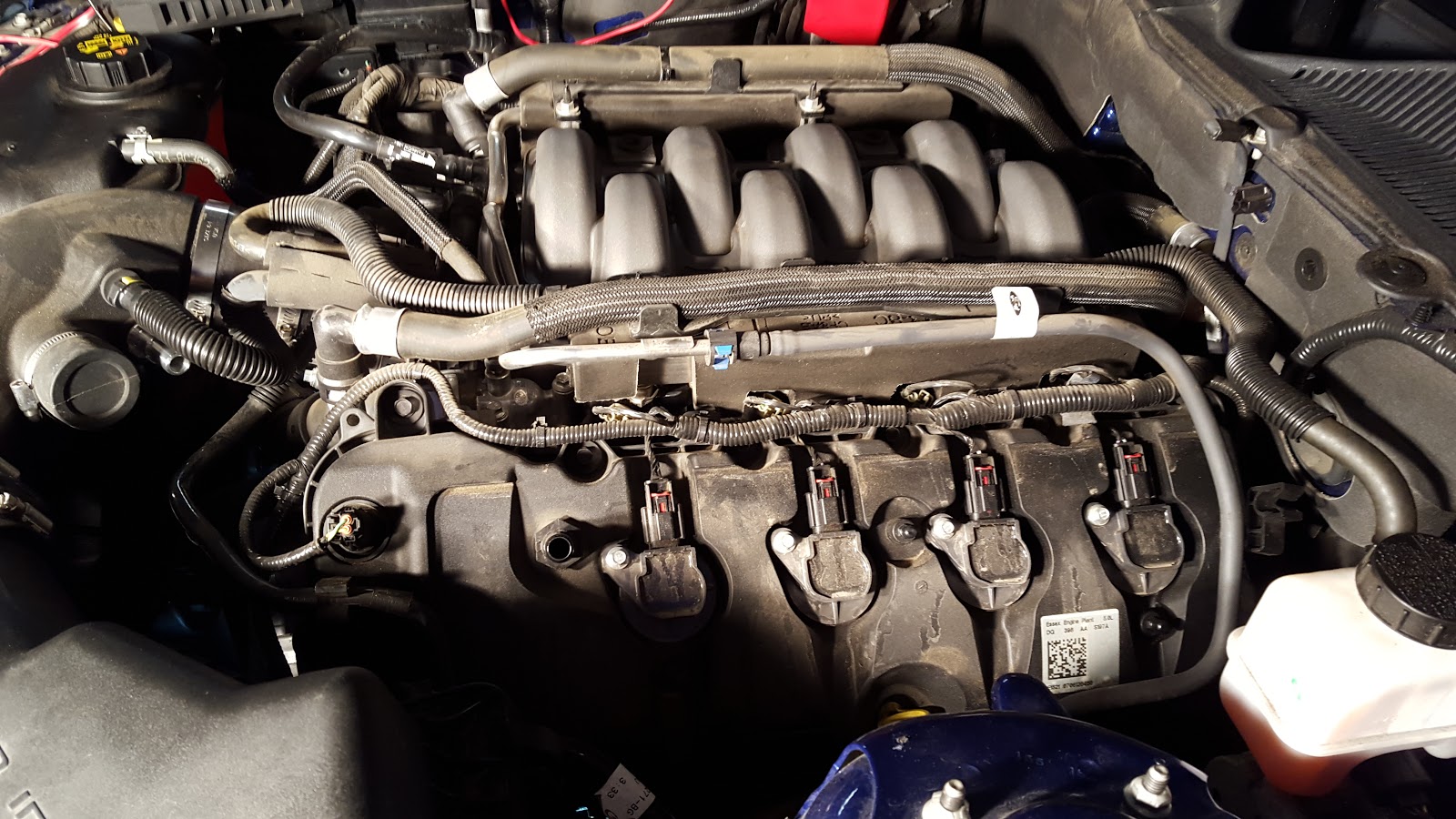
Engine cover removed, "before" pic
Front clip removed, making progress

While the front clip was removed, I added a GT500 upper and lower grille to improve cooling/airflow


Added a Roush gauge pod with an Autometer boost gauge.  I went with the 0-15 psi gauge.

Coils exposed, prior to the install I swapped to 1 step colder NGK plugs
Old plugs removed and numbered, going with 7.5 psi of boost I wound up going 1 step colder on the spark plugs.

Procharger P1SC, still in the box

Procharger neatly labels each package in the box.  Each package corresponds to a different step in the install process, pretty awesome.

Procharger provides color instructions, which make the install much easier.


The finished product, you can see the new coolant degas tank provided in the Procharger kit


Finished adding 200+ horsepower with a simple bolt on!  


Thursday, May 14, 2015

2013 Mustang GT - Lowering with SR Performance Springs and Adjustable Panhard Bar

The 2011-2013 Mustang GT comes from the factory with a lot of wheel gap.  I set out to fix this by installing a set of SR Performance lowering springs from www.americanmuscle.com

Look at all that wheel gap...


I snagged these on Cyber Monday for $99, and wound up getting an adjustable panhard bar for Christmas.

I tackled the back of the car first, as it seemed the easiest.


After debating where to place the jack stands (and jack), I found this handy diagram of a 2011-2014 Mustang GT with proper jack stand, jack, and lifting positions.

The adjustable panhard bar and SR lowering springs, prior to installation


The sway bar end links are one of many items that must be unbolted in order to successfully complete the install. 

The stock spring prior to removal, notice the pigtail at the bottom of the coil pointing to the rear of the car.

The Old vs the New - Shown above you can see the height difference between the two springs

The SR Performance spring dropped into place

Another shot of the driver's side rear spring

 When installing the panhard bad, I made the mistake of just spinning one side in order to get the initial length right.  This took away all of my adjustment when I went to center the rearend.

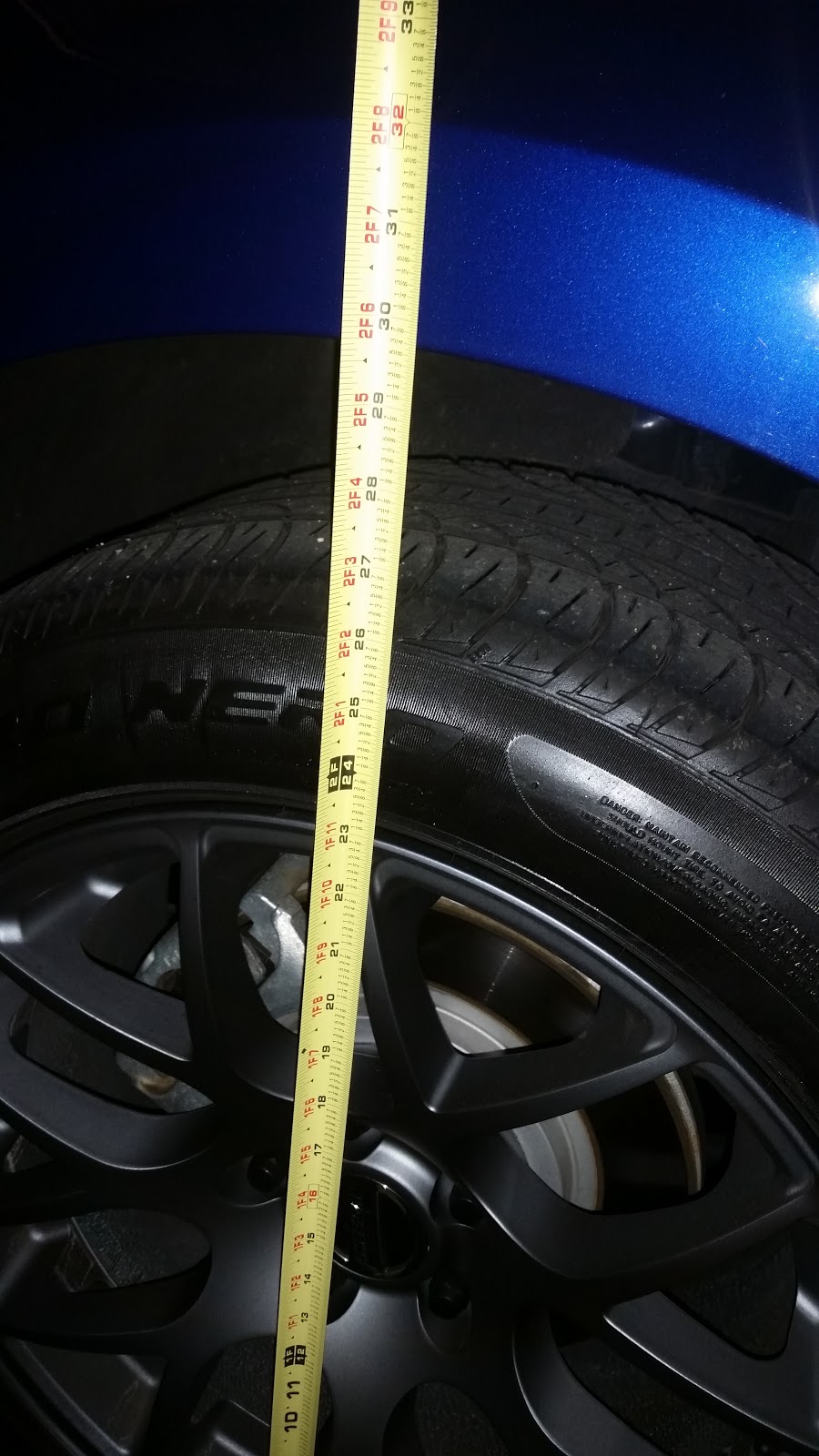
Pre-drop, you can see just under 30" to the top of the wheel well.  Look at all of that wheel gap!


Post-drop height - The car should settle more after being driven, you can see roughly 1 1/2" of drop so far.  I used a plumb bob to check the centering of the rearend, and found that lowering the car had adjusted the rearend about 1/2" to the driver's side of the car.  I was able to correct this with the adjustable panhard bar.


Here you can see, after removing the panhard bar and correctly adjusting it, I now can adjust the centering of the rearend.  The rearend ends up getting adjusted with the car on the ground, and the body of the car actually shifts instead of the rearend, which is opposite of what most think.  Also, be sure to use loctite on the nuts, so they do not back off.

Post drop - Much better!

Now on to the front of the car.  The front is a lot more involved, as you cannot simply remove the springs like you can in the rear.  The front springs must be compressed and removed, either with a spring compressor, or the weight of the car and a jack.  Personally, I am not a fan of spring compressors, and chose to use latter method.

Pre-drop height

Wheel Off, now the fun begins

Removing the strut bolts to begin the process

Another shot

One of the many challenges nobody talks about, you either need to use an impact, or a specialty nut to successfully back the strut nut, and remove it.  You simply cannot get a wrench or a crow's foot on the strut nut as pictured.

Out with the old, in with the new


The front suspension, torn apart

The SR Performance lowering spring installed on the passenger side

(The Finished Product)